Latest Entries

Accessing filtered websites from behind a network firewall

Stuck behind a firewall restricting your access to the Internet?  You may have already tried HotSpot Shield or various other anonymous proxies with some luck.  But what happens when your Internet Service Provider (ISP) finds the server’s address and then blocks it?  You’ll have to wait for HotSpot Sheild to change their address or find a new anonymous proxy…

Here’s a better solution: Tor.

Tor is like the underground railroad of the internet.  There are an incredible amount of reasons why YOU should be using Tor.  Even if you have no problems accessing the social networks, you are being logged everywhere you go: 216.73.216.224.

The way Tor deals with anonymity is by creating a vast network of distributed anonymous relays.  Instead of taking your information straight from source to destination, it will instead go through the maze that is Tor, where each relay is another Tor user.   This makes traffic analysis very difficult.  As well, if you are in Iran or China or someone else that has decided that certain websites are bad for you, there is no one server to block.  Every user that decides to be a relay is a server.

Here’s how to get … Continue reading...

TV Interference

Some images from an idea I am currently playing with using TV interference:

[flickr album=72157623560210298 num=20 size=Square]
Continue reading...

Augmented Sculpture Project

This will be my second year supervising the Digital Media Studio Project at the University of Edinburgh. The course is a mix of over 60 Digital Composition, Sound Design, Digital Design in Media, and Acoustic and Music Technology MSc students. 10-15 supervisors pitch a project proposal and the students decide which ones they’d like to participate in. This year, I proposed Augmented Sculpture, and 3 students signed up of which 2 are Sound Designer and 1 is a Digital Designer. So far, they have managed to communicate tracking data via a reactivision framework and combine life-sized sculpture to interact with a sonic environment built in Max/MSP.

Chandan, Helen and Ev playing with a ReacTIVision controlled Max/MSP patch developed for the Digital Media Studio Project at Edinburgh University. This is the very first ever test run of the system, and it worked!

Follow more developments on their blog.… Continue reading...

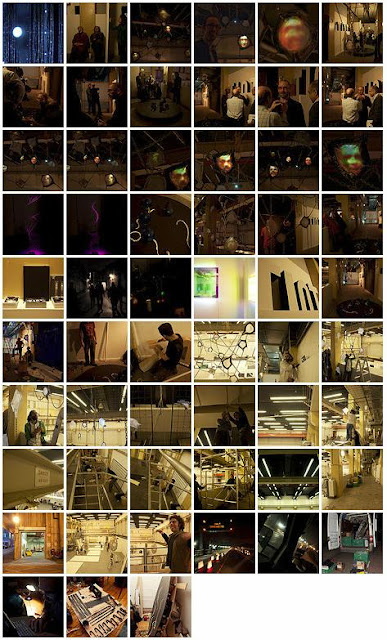
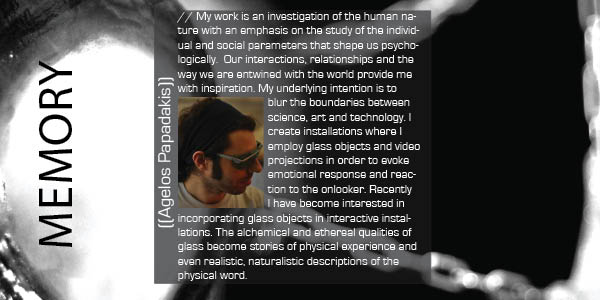
Memory at the Kinetica Art Fair 2010

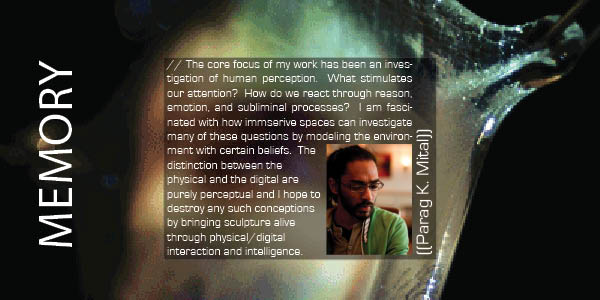
I had the pleasure of exhibiting one of my works, Memory, with glass artist Agelos Papadakis at the Kinetica Art Fair 2010, from February 4-7th, 2010. The work was presented by TINTarts as well as another piece by Dave Murray-Rust, Agelos Papadakis, and Owen Green, called ChaoDependant. The fair was an incredible selection of contemporary artists and historical collections of kinetic and interactive art. I’ll be looking forward to next year.

Also worth checking out is a panorama with some interesting viewing options: www.z360.com/full/kinetica/
If you click to find the ‘Balcony’, you will see both ChaoDependant and Memory off to the side as well as Dave Murray-Rust and Agelos Papadakis in the foreground. 

As well, here is a link to our work on artstream: http://www.artstream.org/artists/view/250

I’ve also uploaded pictures on my flickr account

Continue reading...

Polychora (AV Synaesthesia)

Polychora stands for a 4 dimensional polytope, a connected or closed figure of lower dimesnional polytopal elements. These elements are thought of as the impulses of the piece and their combinations are intricately explored and decomposed in order to create a soundscape of particles. As an exploration of synaesthesia, the visuals are created as an audio-reactive algorithm based on brightness, panning, texture, noisiness, pitch, and their combinations. By combining the amorphous space of possible impulses and the range of sound textures, the polychoron takes a visual shape altered by the different dimensions of texture.

This piece was presented at the Soundings Festival on February 6th and 7th, 2010 (curated by Andrew Connor).
http://www.music.ed.ac.uk/soundings/

Audio by Christos Michalakos: http://christosmichalakos.com/

Visuals by Parag K Mital: http://pkmital.com/… Continue reading...

Soundings Festival

As part of an audio-visual collaboration, Christos Michalakos and myself have experimented with a possible rendering, Polychora, for submission to the Soundings Festival. I’m happy to announce that our piece was selected and will be presented on February 6th as part of the evening festival, 6 p.m. at the Reid Concert Hall, Bristo Square, Edinburgh, Scotland. Uploaded here are a few stills from the video:


As well, a short description of the piece:
Christos Michalakos & Parag K Mital – Polychora:

Polychora stands for a 4 dimensional polytope, a connected or closed figure of lower dimesnional polytopal elements.  These elements are thought of as the impulses of the piece and their combinations are intricately explored and decomposed in order to create a soundscape of particles.  As an exploration of synaesthesia, the visuals are created as an audio-reactive algorithm based on brightness, panning, texture, noisiness, pitch, and their combinations.  By combining the amorphous space of possible impulses and the range of sound textures, the polychoron takes a visual shape altered by the different dimensions of texture.

Continue reading...

Free Improvisation Jam

Recorded Jan 15 2010. Have a listen:

Fork ft. Paul Keene

w/

Marcin Kowalczyk – Alto Saxophone
Paul Keene – Electronic Keyboard
Parag K. Mital – Electric Bass Guitar
Christos-George Michalakos – Acoustic Drums & Electronics… Continue reading...

Add-art

TINT’s online exhibition using Add-art has gone live!

Here is what the website has to say about our piece:

Parag K Mital and Agelos Papadakis – Memory
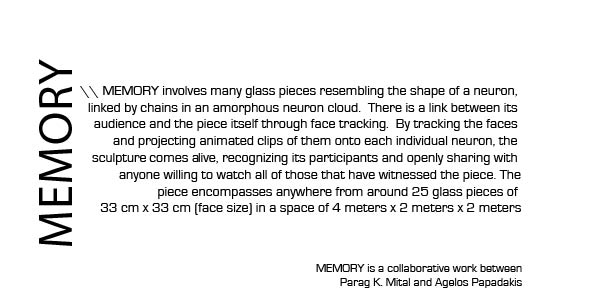
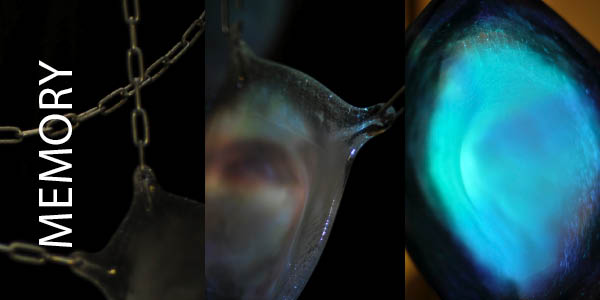
Parag K Mital and Agelos Papadakis have worked together on a number of occasions, their piece Memory, being the most celebrated. In this piece, they explore augmented sculpture in an installation environment, allowing the audience to become an integral part of the sculpture. Creating great tension in the viewer, they have literally chained together brilliant works of glass resembling neurons to create entangling neural networks of 25 face-sized glass pieces together in a 3×3×5 meter industrial warehouse space. Within two of the glass neurons are hidden cameras tracking audience member’s faces and recording them to a computer hidden above. Using a projector and projection mapping onto each neuron, a recorded clip of one of its audience members plays as a neural network of different faces occasionally firing with a mesmerizing display. Through the disarrayed glass, ones face morphs ever so slightly, though those familiar with that face are able to recognize it still. However, the majority of faces may seem unknown to the audience members and serve merely as a memory of the

Continue reading...

Hidden Door @ The Roxy Art House, Edinburgh

hidden door
A gathering is approaching Edinburgh at the end of the month and it will include film screenings, poetry readings, art exhibitions, live electronics, live bands, live visuals, networked performances, streaming cameras and sound, brilliant people (including you), drinks, and probably a lot more at the Roxy Art House in Edinburgh from Jan 30-31.  I will also be performing audio-reactive visuals during a live electronic set by Michael Baldock together with a sculptural surface by Agelos Papadakis.  More details to follow but get your tickets now as they are half price this week (10 pounds for the weekend as opposed to 20 pounds).  Check out more information on the website as it is being updated.… Continue reading...

Memory, Kinetica Art Fair, & SketchUp

As part of the Kinetica Art Fair 2010, Memory is required to fill in a risk assessment form.  This entails listing out all the possibly tragic events that can occur, how many people could potentially die, and a design of the installation as seen from top-down and the side.  Having only seen pictures of the space before, deciding on the design was a bit tricky (let alone figuring out how many people would die).  The piece itself is not very modular and has to make use of the space (take a look at what I mean).  It is basically a web that latches onto whatever it can find in the space.  As such, we really needed a nice model of the space in order to model the installation.

I went through an attempt of photoshopping the few pictures with some ridiculous looking lines.  It didn’t seem to capture the space.  Next attempt was with Illustrator.  Hmm.  Nope not much further.  Maybe just draw the thing?  Nope.  I couldn’t seem to get the scale right or even think about how to lay out the design in a space I wasn’t really sure about.  I just couldn’t visualize the … Continue reading...

Kinetica Art Fair 2010

Book your tickets to London now, folks.  Memory is going back to London for the Kinetica Art Fair 2010, Feb 4-7 @ the Kinetica Museum, Spitalfield, London presented by TINTarts.  <3 TINTarts… Continue reading...

Add-art

If you aren’t using Adblock Plus, you should be.  If you are, you should be using Add-art.  This clever extension will replace all online advertisements with pictures of art.

Now for the real news, TINTarts has selected a number of pieces to be part of an online add-art exhibition starting January 16th and Memory will be one of them.  Get your add-art now and leave a comment if you happen to see Memory while browsing.… Continue reading...

Tagging Your World

Though AR has been around for awhile (ACM Special Issue in 1993 though dedicated conferences beginning in 1997), it seems to be at a point where it is finally hitting the mainstream.  A number of development libraries have been around for awhile (ARToolkit, FlARToolkit, ARTAGD’Fusion @Home, Mixed Reality Toolkit (MRT), Unifeye Viewer XtraMirage Builder, and Studierstube Tracker). Though with the advent of the iPhone App Market and the Google Android Market Place, we are finally starting to see some practical applications that seem to be a head start towards a meta-tagged world. I’ll continually add more here and try to group them as I see fit. But the basic premise of these applications allows users to create a digital layer over the physical one. I think the SixthSense video demo shows this concept brilliantly (though most of the demo is more concept than reality).

Using the camera to detect features in a scene:

(1) Google Goggles

(2) SixthSense (the demo is more concept than reality)

(3) SREngine

Augmented Reality Browsers (see a comparison of a few here):

(1) Layar

(2) WWSignpost

(3) Wikitude (though this seems … Continue reading...
OpenCV 2.0 Introduces CPP Style Coding and More

No more void *‘s apparently. And they’ve got constructors and destructors.

Check out the documentation here: http://opencv.willowgarage.com/documentation/cpp/index.html

Notably, the memory management seems to be much nicer as destructors are called when there are no more references to the object.

As well, quickly accessing data row or plane major seems to be much easier now:

e.g. plane access:
// split the image into separate color planes
vector planes;
split(img_yuv, planes);

// access with iterators:
MatIterator_ it = planes[0].begin(),
                    it_end = planes[0].end();

As well, they have implemented STL-like class traits for easily declaring matrices with the normal c++ primitives without having to remember CV_64F etc…

e.g.:
Mat A(30, 40, DataType::type);
Mat B = Mat_ >(3, 3);

There is a whole lot more introduced including a revamped interface system, many more machine learning and computer vision algorithms, OMP integration, and probably a lot more.  I’ll be playing with it to see what else is going on.  Hopefully the openframeworks community will pick up on it as well and integrate it into their next major release.  I know I’ll be doing so for my projects.… Continue reading...

Memory (pdf)

I’ve just uploaded an old pdf of the Memory project:

Continue reading...

Public Opinion in Edinburgh of the 2009 Presidential Iranian Election

Filmed during the 2009 Edinburgh Festival Fringe, a small team went around Edinburgh with a cardboard sign that read, “Ask Me About Iran” in order to gather people’s thoughts on the events surrounding the recent Iranian election.

Filmed with a Nikon D90.… Continue reading...

Perception Related Videos

Seeing as how many interesting talks are being collected in online video databases such as videolectures, mit world, academic earth, opencourseware, ted, uctv, or the nih videocasts, just to name a few, I’ve started to collect a few of the interesting talks that are related to perception.

You can find them here.… Continue reading...

DIEM Website

The DIEM Project (Dynamic Images and Eye Movements) has a sleek new website which you can check out here: http://www.psy.ed.ac.uk/diemContinue reading...


Copyright © 2010 Parag K Mital. All rights reserved. Made with Wordpress. RSS