Archived entries for

Course @ CEMA Srishti School of Design, Bangalore, IN

From November 21st to the 2nd of December, I’ll have the pleasure to lead a course and workshop with Prayas Abhinav at the Center for Experimental Media Arts in the Srishti School of Design in Banaglore, IN.  Many thanks to Meena Vari for all her help in organizing the project.

Stories are flowing trees

Key words:  3D, interactive projects, data, histories, urban, creative coding, technology, sculpture, projection mapping

Project Brief:

Urban realities are more like fictions, constructed through folklore, media and policy. Compressing these constructions across time would offer some possibilities for the emergence of complexity and new discourse. Using video projections adapted for 3D surfaces, urban histories will become data and information – supple, malleable, and material.

The project will begin with a one week workshop by Parag Mital on “Creative Coding” using the openFrameworks platform for C/C++ coding”.

About the Artists:

Prayas Abhinav

Presently he teaches at the Srishti School of Art, Design and Technology and is a researcher at the Center for Experimental Media Arts (CEMA). He has taught in the past at Dutch Art Institute (DAI) and Center for Environmental Planning and Technology (CEPT).
He has been supported by fellowships by Openspace India (2009), TED (2009), … Continue reading...
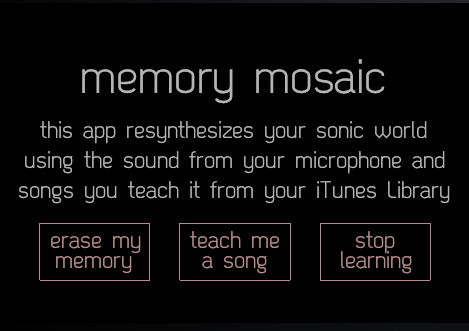
Memory Mosaicing

A product of my PhD research is now available on the iPhone App Store (for a small cost!): View in App Store.

This application is motivated by my interests in experiencing an Augmented Perception and of course very much inspired by some of the work here at Goldsmiths. The application of existing approaches in soundspotting/mosaicing to a real-time stream and situated in the real-world allows one to play with their own sonic memories, and certainly requires an open ear for new experiences. Succinctly, the app records segments of sounds in real-time using it’s own listening model, as you walk around in different environment (or sit at your desk). These segments are constantly built up the longer the app is left running to form a database (working memory model) for which to understand new sounds. Incoming sounds are then matched to this database and the closest matching sound is played instead. What you get is a polyphony of sound memories triggered by the incoming feed of audio, and an app which sounds more like your environment the longer it is left to run. A sort of gimmicky feature of this app is the ability to learn a song from your … Continue reading...


Copyright © 2010 Parag K Mital. All rights reserved. Made with Wordpress. RSS