Archived entries for concatenative synthesis

Memory Mosaic iOS – Generative Audio Mashup App

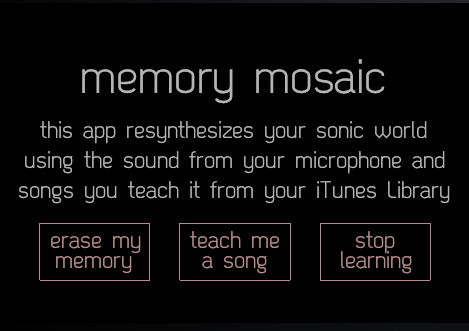
I had a chance to incorporate some udpates into Memory Mosaic, an iOS app I started developing during my PhD in Audiovisual Scene Synthesis. The app organizes sound in real-time and clusters them based on similarity. Using the microphone on the device, or an iTunes song, any onset triggers a new audio segment to be created and stored in a database. The example video below shows how this works for Do Make Say Think’s song, Minim and The Landlord is Dead:

Memory Mosaic iOS from Parag K Mital on Vimeo.

Here’s an example of using it with live instruments

Memory Mosaic – Technical Demo (iOS App) from Parag K Mital on Vimeo.

The app also works with AudioBus, meaning you can use it with other apps too, adding effects chains, or sampling from another app’s output.  Available on the iOS App Store: https://itunes.apple.com/us/app/memory-mosaic/id475759669?mt=8… Continue reading...
3D Musical Browser

I’ve been interested in exploring ways of navigating media archives. Typically, you may use iTunes and go from artist to artist, or have managed to tediously classify your collection into genres. Some may still even browse their music through a file browser, perhaps making sure the folders and filenames of their collection are descriptive of the artist, album, year, etc… Though what about how the content actually sounds?

Wouldn’t it be nice to hear all music which shares similar sounds, or similar phrases of sounds? Research in the last 10-15 years have developed methods precisely to solve this problem and fall under the umbrella term content-based information retrieval (CBIR) algorithms, or uncovering the relationships of an archive through the information within the content. For images, Google’s Search by Image is a great example which only recently became public. For audio, audioDB and ShaZam are good examples of discovering music through the way it sounds, or the content-based relationships of the audio itself. Though, each of these interfaces present a list of matches to a image or audio query, making exploring the content-based relationships of a specific set of material difficult.

The video above demonstrates interaction with a novel 3D browser … Continue reading...

Intention in Copyright

The following article is written for the LUCID Studio for Speculative Art based in India.

Introduction

My work in audiovisual resynthesis aims to create models of how humans represent and attend to audiovisual scenes. Using pattern recognition of both audio and visual material, these models use large corpora of learned audiovisual material which can be matched to ongoing streams of incoming audio or visual material. The way audio and visual material is stored and segmented within the model is based heavily on neurobiology and behavioral evidence (the details are saved for another post). I have called the underlying model Audiovisual Content-based Information Description/Distortion (or ACID for short).

As an example, a live stream of audio may be matched to a database of learned sounds from recordings of nature, creating a re-synthesis of the audio environment at present using only pre-recorded material from nature itself. These learned sounds may be fragments of a bird chirping, or the sound of footsteps. Incoming sounds of someone talking may then be synthesized using the closest sounding material to that person talking, perhaps a bird chirp or a footstep. Instead of a live stream, one can also re-synthesize a pre-recorded stream. Consider using a database … Continue reading...

Memory Mosaicing

A product of my PhD research is now available on the iPhone App Store (for a small cost!): View in App Store.

This application is motivated by my interests in experiencing an Augmented Perception and of course very much inspired by some of the work here at Goldsmiths. The application of existing approaches in soundspotting/mosaicing to a real-time stream and situated in the real-world allows one to play with their own sonic memories, and certainly requires an open ear for new experiences. Succinctly, the app records segments of sounds in real-time using it’s own listening model, as you walk around in different environment (or sit at your desk). These segments are constantly built up the longer the app is left running to form a database (working memory model) for which to understand new sounds. Incoming sounds are then matched to this database and the closest matching sound is played instead. What you get is a polyphony of sound memories triggered by the incoming feed of audio, and an app which sounds more like your environment the longer it is left to run. A sort of gimmicky feature of this app is the ability to learn a song from your … Continue reading...


Copyright © 2010 Parag K Mital. All rights reserved. Made with Wordpress. RSS