Archived entries for iphone

Memory Mosaicing

A product of my PhD research is now available on the iPhone App Store (for a small cost!): View in App Store.
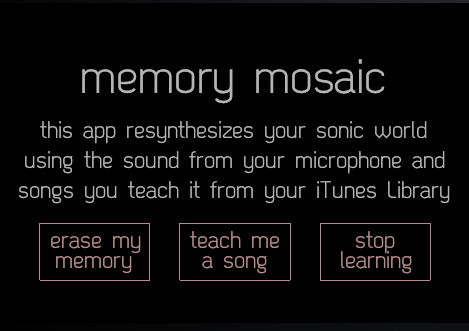
This application is motivated by my interests in experiencing an Augmented Perception and of course very much inspired by some of the work here at Goldsmiths. The application of existing approaches in soundspotting/mosaicing to a real-time stream and situated in the real-world allows one to play with their own sonic memories, and certainly requires an open ear for new experiences. Succinctly, the app records segments of sounds in real-time using it’s own listening model, as you walk around in different environment (or sit at your desk). These segments are constantly built up the longer the app is left running to form a database (working memory model) for which to understand new sounds. Incoming sounds are then matched to this database and the closest matching sound is played instead. What you get is a polyphony of sound memories triggered by the incoming feed of audio, and an app which sounds more like your environment the longer it is left to run. A sort of gimmicky feature of this app is the ability to learn a song from your … Continue reading...

Short Time Fourier Transform using the Accelerate framework

Using the libraries pkmFFT and pkm::Mat, you can very easily perform a highly optimized short time fourier transform (STFT) with direct access to a floating-point based object.

Get the code on my github:
http://github.com/pkmital/pkmFFT
Depends also on: http://github.com/pkmital/pkmMatrixContinue reading...

Real FFT/IFFT with the Accelerate Framework

Apple’s Accelerate Framework can really speed up your code without thinking too much. And it will also run on an iPhone. Even still, I did bang my head a few times trying to get a straightforward Real FFT and IFFT working, even after consulting the Accelerate documentation (reference and source code), stackoverflow (here and here), and an existing implementation (thanks to Chris Kiefer and Mick Grierson). Still, the previously mentioned examples weren’t very clear as they did not handle the case of overlapping FFTs which I was doing in the case of a STFT or they did not recover the power spectrum, or they just didn’t work for me (lots of blaring noise).

Get the code on my github:
http://github.com/pkmital/pkmFFTContinue reading...


Copyright © 2010 Parag K Mital. All rights reserved. Made with Wordpress. RSS