Archived entries for collage

Neural Audio Decollage – Whale Sounds

I put some music together this winter which you can hear on soundcloud:

It features both some neural audio decollage and the voice of Jessa Carter. The decollage works with the material of Four Tet and Burial’s Moth and recomposes the track by John Tejada – Farther and Fainter.… Continue reading...

UCLA Course on “Cultural Appropriation with Machine Learning”

During the Fall of 2020, I had the honor of teaching a new course at the University of California in Los Angeles (UCLA) Department of Design Media Arts (DMA) entitled “Cultural Appropriation with Machine Learning”. This provocatively titled course came together after wrestling with many questions I had that year in the wake of the pandemic, black civil rights movements, and a crushed economy.

Rather than teach a course that focuses purely on the “how” of machine learning, like Creative Applications of Deep Learning does, I wanted to also include a critical component to guide students through the questions they should be asking as they learn and employ these tools. I also wanted students to understand how these tools and algorithms came to be in today’s society, so that they knew better what questions to ask when they were using them. It became clear early on that cultural appropriation was a central theme across most generative arts practices. I say this because machine learning requires large amounts of data which tend to come from existing corpora of creative content, such as flickr archives, or instagram collections. What does it mean when an algorithm owned by Google or Microsoft is capable … Continue reading...

YouTube’s “Copyright School” Smash Up

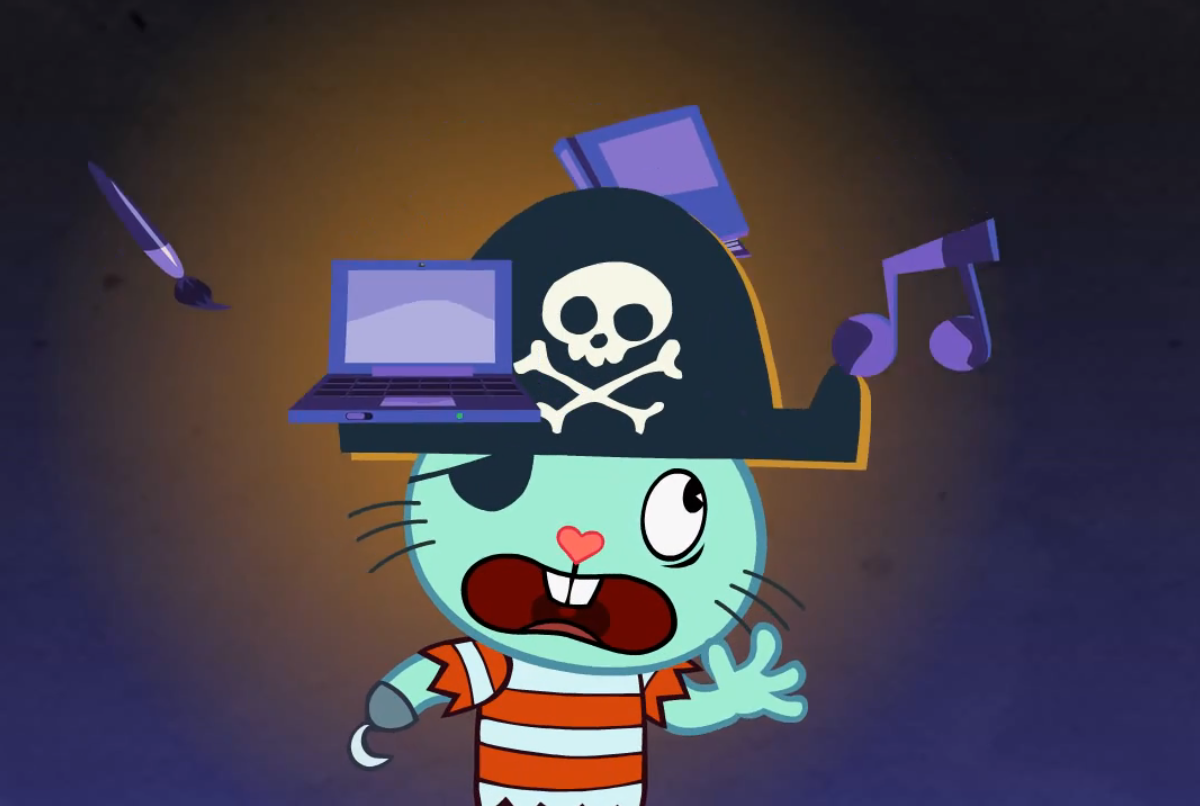
Ever wonder what happens when you’ve been accused of violating copyright multiple times on YouTube? First, you get a redirect to YouTube’s “Copyright School” whenever you visit YouTube, forcing you to watch a cartoon of Happy Tree Friends where the main character is dressed as an actual pirate:
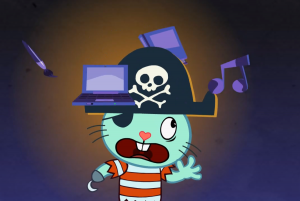
Second, I’m guessing, your account will be banned. Third, you cry and wonder why you ever violated copyright in the first place.

In my case, I’ve disputed every one of the 4 copyright violation notices that I’ve received under grounds of Fair Use and Fair Dealing. Here’s what happens when you file a dispute using YouTube’s online form (click for high-res):

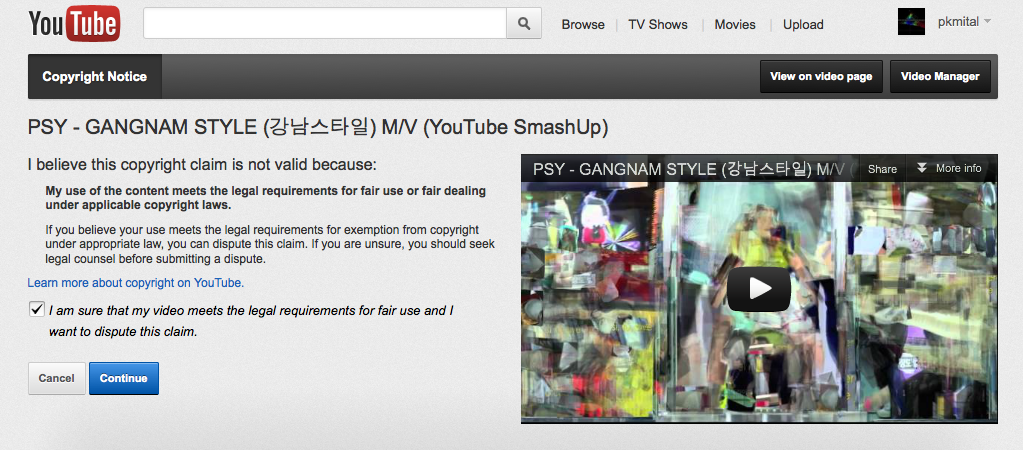

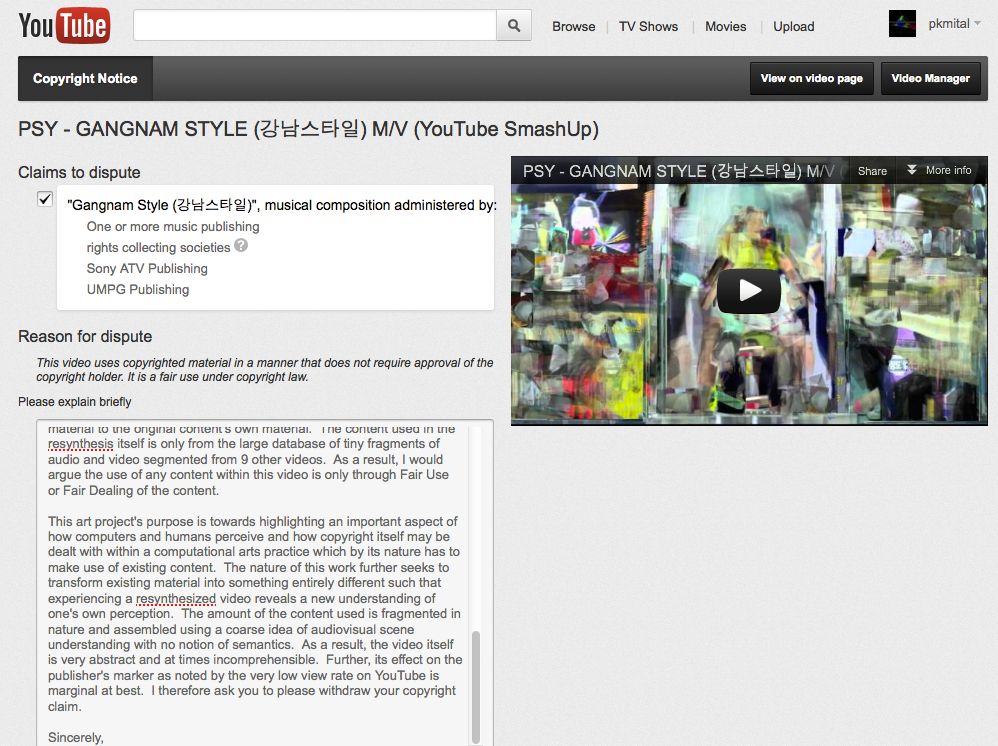


3 of the 4 have been dropped after I’ve filed disputes, though I’m still waiting to hear about the response to the above dispute. Read the dispute letter to Sony ATV and UPMG Publishers in full here.

The picture above shows a few stills from what my Smash Ups look like. The process described in greater detail on createdigitalmotion.com is part of my ongoing research into how existing content can be transformed into artistic styles reminiscent of analytic cubist, figurative, and futurist paintings. The process to create the videos … Continue reading...
An open letter to Sony ATV and UMPG

Dear Sony ATV Publishing, UMPG Publishing, and other concerned parties,

I ask you to please withdraw your copyright violation notice on my video, “PSY – GANGNAM STYLE (?????) M/V (YouTube SmashUp)” as I believe my use of any copyrighted material is protected under Fair Use or Fair Dealing. This video was created by an automated process as part of an art project developed during my PhD at Goldsmiths, University of London: http://archive.pkmital.com/projects/visual-smash-up/ and http://archive.pkmital.com/projects/youtube-smash-up/

The process which creates the audio and video is entirely automated meaning the accused video is created by an algorithm. This algorithm begins by first creating a large database of tiny fragments of audio and video (less than 1 second of audio per fragment) using 9 videos from YouTube’s top 10 list. From this database, the tiny fragments of video and audio are stored as unrelated pieces of information and described only by a short series of 10-15 numbers. These numbers represent low-level features describing the texture and shape of the fragment of audio or video. These tiny fragments are then matched to the tiny fragments of audio and video detected within the target for resynthesis, in this case the number one YouTube video … Continue reading...

Copyright Violation Notice from “Rightster”

I’ve been working on an art project which takes the top 10 videos in YouTube and tries to resynthesize the #1 video in YouTube using the remaining 9 videos. The computational model is based on low-level human perception and uses only very abstract features such as edges, textures, and loudness. I’ve created a new synthesis each week using the top 10 of the week in the hopes that, one day, I will be able to resynthesize my own video in the top 10. It is a viral algorithm essentially but it is not proven if it will succeed or not.

The database of content used in the recreation of the above video comes from the following videos:
#2 News Anchor FAIL Compilation 2012 || PC
#3 Flo Rida – Whistle [Official Video]
#4 Carly Rae Jepsen – Call Me Maybe
#5 Jennifer Lopez – Goin’ In ft. Flo Rida
#6 Taylor Swift – We Are Never Ever Getting Back Together
#7 will.i.am – This Is Love ft. Eva Simons
#8 Call Me Maybe – Carly Rae Jepsen (Chatroulette Version)
#9 Justin Bieber – As Long As You Love Me ft. Big Sean
#10 Rihanna – Where Have You Been

It … Continue reading...

Intention in Copyright

The following article is written for the LUCID Studio for Speculative Art based in India.

Introduction

My work in audiovisual resynthesis aims to create models of how humans represent and attend to audiovisual scenes. Using pattern recognition of both audio and visual material, these models use large corpora of learned audiovisual material which can be matched to ongoing streams of incoming audio or visual material. The way audio and visual material is stored and segmented within the model is based heavily on neurobiology and behavioral evidence (the details are saved for another post). I have called the underlying model Audiovisual Content-based Information Description/Distortion (or ACID for short).

As an example, a live stream of audio may be matched to a database of learned sounds from recordings of nature, creating a re-synthesis of the audio environment at present using only pre-recorded material from nature itself. These learned sounds may be fragments of a bird chirping, or the sound of footsteps. Incoming sounds of someone talking may then be synthesized using the closest sounding material to that person talking, perhaps a bird chirp or a footstep. Instead of a live stream, one can also re-synthesize a pre-recorded stream. Consider using a database … Continue reading...


Copyright © 2010 Parag K Mital. All rights reserved. Made with Wordpress. RSS