Archived entries for memory

Intention in Copyright

The following article is written for the LUCID Studio for Speculative Art based in India.

Introduction

My work in audiovisual resynthesis aims to create models of how humans represent and attend to audiovisual scenes. Using pattern recognition of both audio and visual material, these models use large corpora of learned audiovisual material which can be matched to ongoing streams of incoming audio or visual material. The way audio and visual material is stored and segmented within the model is based heavily on neurobiology and behavioral evidence (the details are saved for another post). I have called the underlying model Audiovisual Content-based Information Description/Distortion (or ACID for short).

As an example, a live stream of audio may be matched to a database of learned sounds from recordings of nature, creating a re-synthesis of the audio environment at present using only pre-recorded material from nature itself. These learned sounds may be fragments of a bird chirping, or the sound of footsteps. Incoming sounds of someone talking may then be synthesized using the closest sounding material to that person talking, perhaps a bird chirp or a footstep. Instead of a live stream, one can also re-synthesize a pre-recorded stream. Consider using a database … Continue reading...
Memory Mosaicing

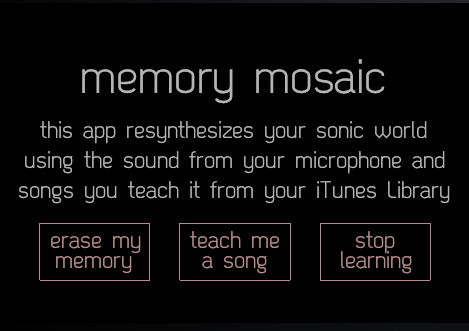
A product of my PhD research is now available on the iPhone App Store (for a small cost!): View in App Store.

This application is motivated by my interests in experiencing an Augmented Perception and of course very much inspired by some of the work here at Goldsmiths. The application of existing approaches in soundspotting/mosaicing to a real-time stream and situated in the real-world allows one to play with their own sonic memories, and certainly requires an open ear for new experiences. Succinctly, the app records segments of sounds in real-time using it’s own listening model, as you walk around in different environment (or sit at your desk). These segments are constantly built up the longer the app is left running to form a database (working memory model) for which to understand new sounds. Incoming sounds are then matched to this database and the closest matching sound is played instead. What you get is a polyphony of sound memories triggered by the incoming feed of audio, and an app which sounds more like your environment the longer it is left to run. A sort of gimmicky feature of this app is the ability to learn a song from your … Continue reading...

“Memory” Video @ AVAF 2010

Please rate, share, and comment!

Memory @ AVAF 2010 from pkmital on Vimeo.

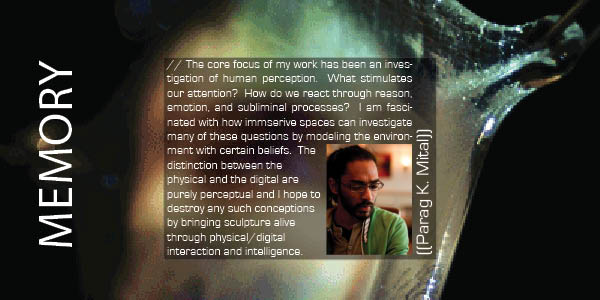
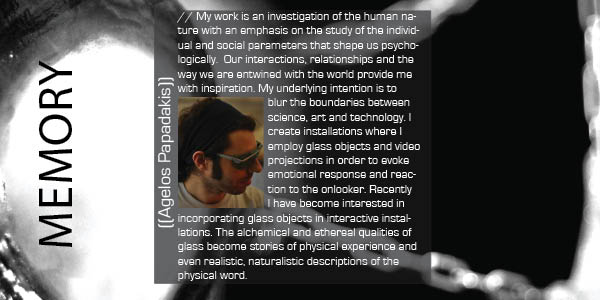
‘Memory’ is an augmented installation of a neural network by Parag K Mital & Agelos Papadakis.
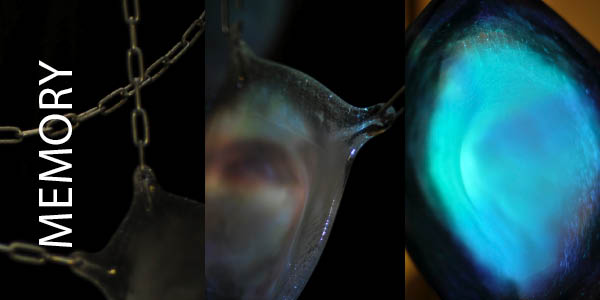
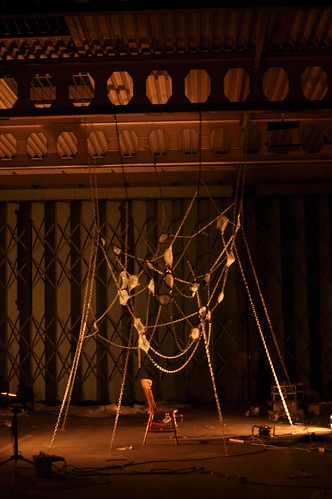
hand blown glass, galvanized metal chain, projection, cameras; 1.5m x 2.5m x 3m

Ghostly images of faces appear as recorded movie clips within neural-shaped hand-blown glass pieces. As one begins to look at the neurons, they notice the faces as their own, trapped as disparate memories of a neural network.

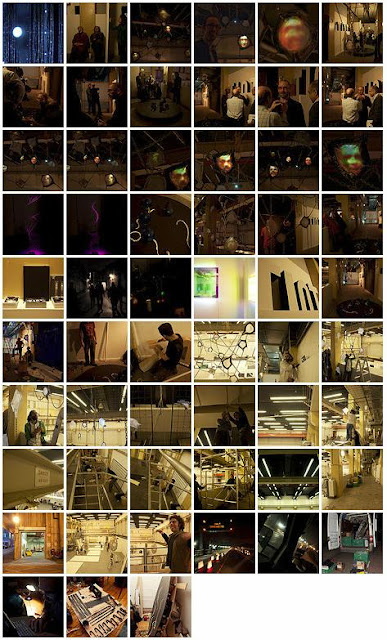
Filmed and installed for the Athens Video Art Festival in May 2010 in Technopolis, Athens, Greece. The venue is a disused gas factory converted art space.

Also seen at Kinetica Art Fair, Ambika P3, London, UK, 2010; Passing Through Exhibition, James Taylor Gallery, London, UK, 2009; Interact, Lauriston Castle, Edinburgh, UK, 2009.

DSC_0466.jpg
DSC_0551.jpg DSC_0420.jpgDSC_0591.jpgDSC_0569.jpgContinue reading...

Memory and ChaoDependant at the Athens Video Art Festival 2010

DSC_0569.jpg May 7-9 saw the 2010 Athens Video Art Festival where with collaborator Agelos Papadakis, Memory saw its latest installation. The venue, a 2,500 square meters disused gas factory called Technopolis, or more commonly referred to as Gazi (Gas), was a brilliant display of warehouse spaces littered by gas pipesDSC_0063.jpg and oil still dripping from the cracks.

DSC_0180.jpg

Over 2,700 submissions were received for a total of 450 presenting artists to see over 13,000 visitors during the weekend. Among the hundreds of video art, animations, and installations, were a number of performances including dance and music.

DSC_0591.jpg

DSC_0420.jpg

Both myself and collaborator Agelos Papadakis were interviewed by ERT, or loosely translated as Hellenic Radio and Television (something like the BBC). It is all in Greek, except for my interview.

Picture 28

Video Link to the interview on EPT.

Feel free to check out pictures from the festival and my travels on my flickr page.… Continue reading...

Memory at the Kinetica Art Fair 2010

I had the pleasure of exhibiting one of my works, Memory, with glass artist Agelos Papadakis at the Kinetica Art Fair 2010, from February 4-7th, 2010. The work was presented by TINTarts as well as another piece by Dave Murray-Rust, Agelos Papadakis, and Owen Green, called ChaoDependant. The fair was an incredible selection of contemporary artists and historical collections of kinetic and interactive art. I’ll be looking forward to next year.

Also worth checking out is a panorama with some interesting viewing options: www.z360.com/full/kinetica/
If you click to find the ‘Balcony’, you will see both ChaoDependant and Memory off to the side as well as Dave Murray-Rust and Agelos Papadakis in the foreground. 

As well, here is a link to our work on artstream: http://www.artstream.org/artists/view/250

I’ve also uploaded pictures on my flickr account

Continue reading...

Add-art

TINT’s online exhibition using Add-art has gone live!

Here is what the website has to say about our piece:

Parag K Mital and Agelos Papadakis – Memory
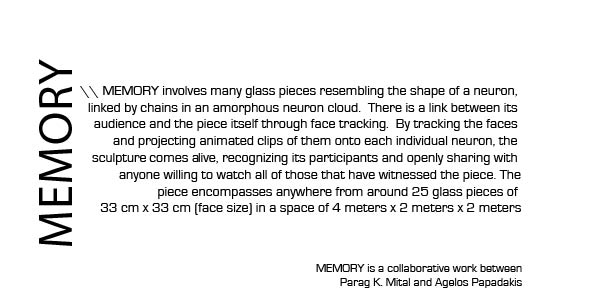
Parag K Mital and Agelos Papadakis have worked together on a number of occasions, their piece Memory, being the most celebrated. In this piece, they explore augmented sculpture in an installation environment, allowing the audience to become an integral part of the sculpture. Creating great tension in the viewer, they have literally chained together brilliant works of glass resembling neurons to create entangling neural networks of 25 face-sized glass pieces together in a 3×3×5 meter industrial warehouse space. Within two of the glass neurons are hidden cameras tracking audience member’s faces and recording them to a computer hidden above. Using a projector and projection mapping onto each neuron, a recorded clip of one of its audience members plays as a neural network of different faces occasionally firing with a mesmerizing display. Through the disarrayed glass, ones face morphs ever so slightly, though those familiar with that face are able to recognize it still. However, the majority of faces may seem unknown to the audience members and serve merely as a memory of the

Continue reading...

Memory, Kinetica Art Fair, & SketchUp

As part of the Kinetica Art Fair 2010, Memory is required to fill in a risk assessment form.  This entails listing out all the possibly tragic events that can occur, how many people could potentially die, and a design of the installation as seen from top-down and the side.  Having only seen pictures of the space before, deciding on the design was a bit tricky (let alone figuring out how many people would die).  The piece itself is not very modular and has to make use of the space (take a look at what I mean).  It is basically a web that latches onto whatever it can find in the space.  As such, we really needed a nice model of the space in order to model the installation.

I went through an attempt of photoshopping the few pictures with some ridiculous looking lines.  It didn’t seem to capture the space.  Next attempt was with Illustrator.  Hmm.  Nope not much further.  Maybe just draw the thing?  Nope.  I couldn’t seem to get the scale right or even think about how to lay out the design in a space I wasn’t really sure about.  I just couldn’t visualize the … Continue reading...

Kinetica Art Fair 2010

Book your tickets to London now, folks.  Memory is going back to London for the Kinetica Art Fair 2010, Feb 4-7 @ the Kinetica Museum, Spitalfield, London presented by TINTarts.  <3 TINTarts… Continue reading...

Add-art

If you aren’t using Adblock Plus, you should be.  If you are, you should be using Add-art.  This clever extension will replace all online advertisements with pictures of art.

Now for the real news, TINTarts has selected a number of pieces to be part of an online add-art exhibition starting January 16th and Memory will be one of them.  Get your add-art now and leave a comment if you happen to see Memory while browsing.… Continue reading...

Memory (pdf)

I’ve just uploaded an old pdf of the Memory project:

Continue reading...

openFrameworks.info

Roxlu at Apollo Media has setup a nice new website that combines resources and recent projects made with openFrameworks. I’m not sure if this website will be set “against” the openframeworks.cc website or if they will focus on different things. Hopefully it don’t divide the community but foster its growth. In any case, they’ve put a nice blurb about Memory on their website 🙂 In time I imagine the website will expand with more resources for oFw developers and those wanting to learn oFw. Speaking of which, some folk here in Edinburgh are organizing a creative coding workshop in late August tba. Stay tuned!… Continue reading...

Memory

I’ve recently finished up a project in collaboration with a Glass Artist, Agelos Papadakis. We built a structure of 25 glass neurons the size of a face and chainded them together in a 3x3x5 meter sculpture. We had 2 cameras hidden in the piece tracking peoples faces and a projector then creating visualizations of the recorded faces resembling something like a cloud of neurons firing in different patterns. We presented it first in Edinburgh at Lauriston Castle’s Glasshouse, and then at the Passing Through exhibit in the James Taylor Gallery in Hackney: http://jamestaylorgallery.co.uk/exhibitions/2009/03/passing-through.html

Image

Image

Image

Image

Image

It’s a bit tricky trying to film the piece since it uses projection onto glass. Sadly I’m left with only a few images that try to portray what went on.

Here’s the code, http://ccrma.stanford.edu/~pkmital/share/Memory.zip It makes use of the openframeworks library so you will need to be familiar with how to setup an XCode project with the openframeworks library if you plan on using it.

The original idea was to use glass balls so that’s why all the code says glassBalls instead of say glassNeurons. If you manage to get it running, press ‘d’ to see the live video input. As it collects faces, it fills up … Continue reading...

INTERact

If anyone has used Google’s event system, they must know how terrible it is. It’s beyond me why if someone changes a detail such as the time from 7 – 10 p.m. to 6 – 9 p.m., Google then sends out e-mails to all guests saying the “Event is canceled”.

Great, thanks Google.… Continue reading...

((MEMORY)) Testing (more pictures)

Some close ups of the testing:


Artists interpretation by Varun Cursetji:

Continue reading...

((MEMORY)) Installation

Working with Agelos Papadakis, this installation will investigate interactivity, agency, and memory within an installation space. Can an art piece evolve and contain the memory of its participants? Is reaction simply a side-effect of art or *the* effect?

More to come… Exhibit in late April.


((MEMORY)) installation on Vimeo.… Continue reading...

Copyright © 2010 Parag K Mital. All rights reserved. Made with Wordpress. RSS