Archived entries for optical flow

Toolkit for Visualizing Eye-Movements and Processing Audio/Video

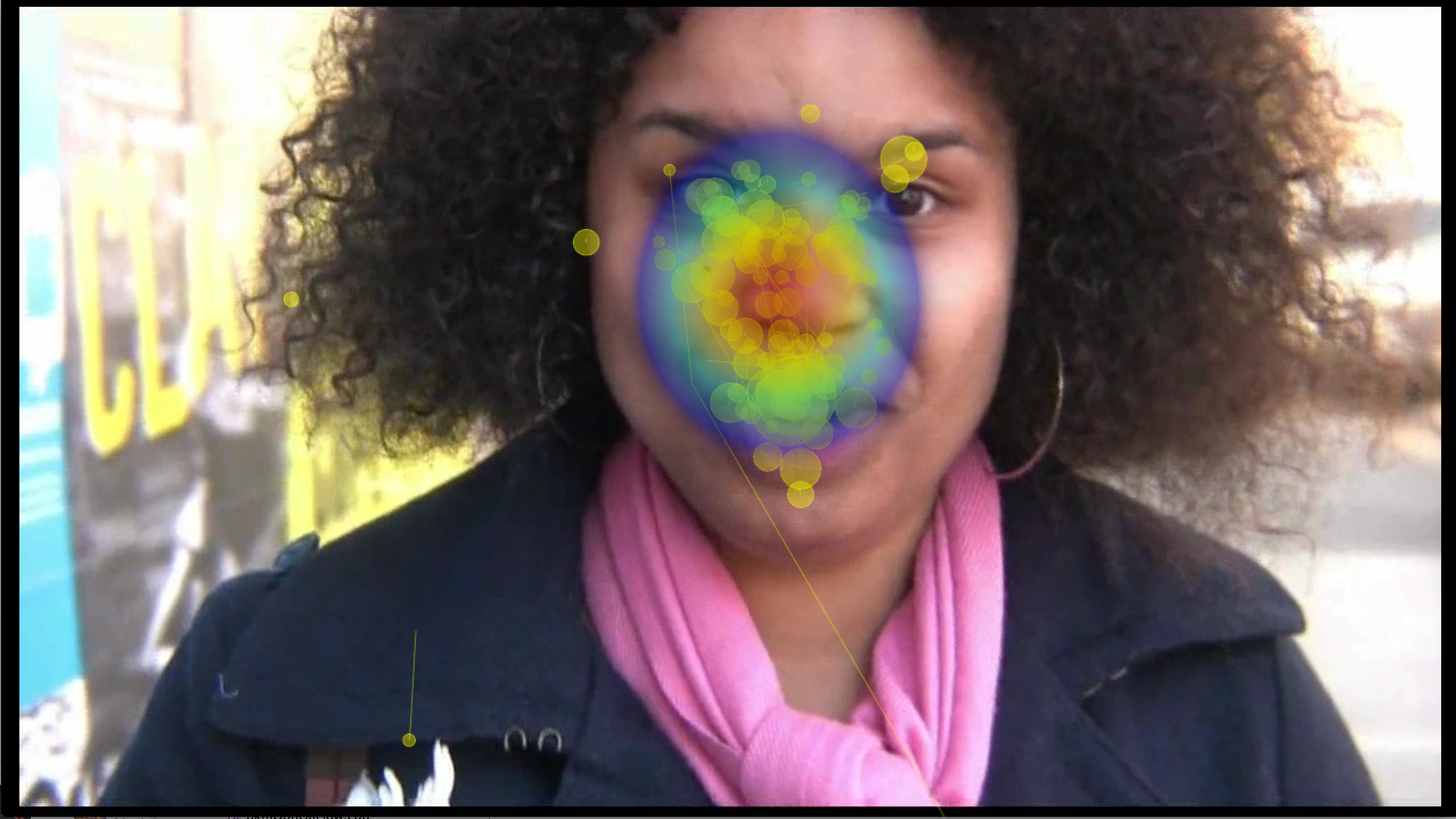
Screen Shot 2015-02-06 at 6.24.27 PM

Original video still without eye-movements and heatmap overlay copyright Dropping Knowledge Video Republic.

From 2008 – 2010, I worked on the Dynamic Images and Eye-Movements (D.I.E.M.) project, led by John Henderson, with Tim Smith and Robin Hill. We worked together to collect nearly 200 participants eye-movements on nearly 100 short films from 30 seconds to 5 minutes in length. The database is freely available and covers a wide range of film styles form advertisements, to movie and music trailers, to news clips. During my time on the project, I developed an open source toolkit, C.A.R.P.E. to complement D.I.E.M., or Computational Algorithmic Representation and Processing of Eye-movements (Tim’s idea!), for visualizing and processing the data we collected, and used it for writing up a journal paper describing a strong correlation between tightly clustered eye-movements and the motion in a scene. We also output visualizations of our entire corpus on our Vimeo channel. The project came to a halt and so did the visualization software. I’ve since picked up the ball and re-written it entirely from the ground up.

The image below shows how you can represent the movie, the motion in the scene of the movie (represented in … Continue reading...

Total Variational L1 and Anisotropic Huber L1 Optical Flow

In 2007, a very nice implementation of a variational implementation of optical flow was described in: A Duality Based Approach for Realtime TV-L1 Optical Flow by C. Zach et. al. I won’t get into the details too much, but the formulation is described by this equation:

E = int_?{?|I0(x) ? I1(x + u(x))| + |?u| dx}

If you are familiar with the seminal work of Horn and Schunck, you will notice it is fairly similar to their variational formulation:

min_u{ int_?{ (|?u1|^2 + |?u2|^2) d? } + ? int_?{ ((I1(x + u(x)) ? I0(x))^2) d? }

And although it looks incredibly simple now, it is in fact fairly difficult computationally since now both terms are not continuously differentiable. To overcome this difficulty, they follow the work of Rudin-Osher-Fatemi energy for total variation image denoising.

Another big contribution comes in their implementation on the GPU. By linearization of the generally non-convex energy functional shown above, the problem is reduced to a pixel-wise convex energy minimization problem. Additionally, by employing coarse-to-fine image pyramids, they are able to account for both small and large movements. Luckily, graphics cards are great at doing both of these sorts of computations very quickly. You … Continue reading...


Copyright © 2010 Parag K Mital. All rights reserved. Made with Wordpress. RSS