Archived entries for information retrieval

YouTube’s “Copyright School” Smash Up

Ever wonder what happens when you’ve been accused of violating copyright multiple times on YouTube? First, you get a redirect to YouTube’s “Copyright School” whenever you visit YouTube, forcing you to watch a cartoon of Happy Tree Friends where the main character is dressed as an actual pirate:

Second, I’m guessing, your account will be banned. Third, you cry and wonder why you ever violated copyright in the first place.

In my case, I’ve disputed every one of the 4 copyright violation notices that I’ve received under grounds of Fair Use and Fair Dealing. Here’s what happens when you file a dispute using YouTube’s online form (click for high-res):

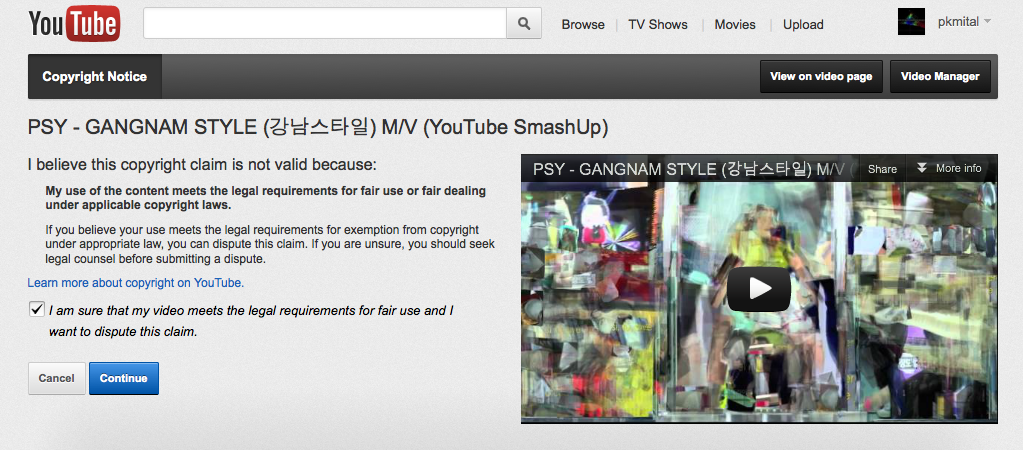

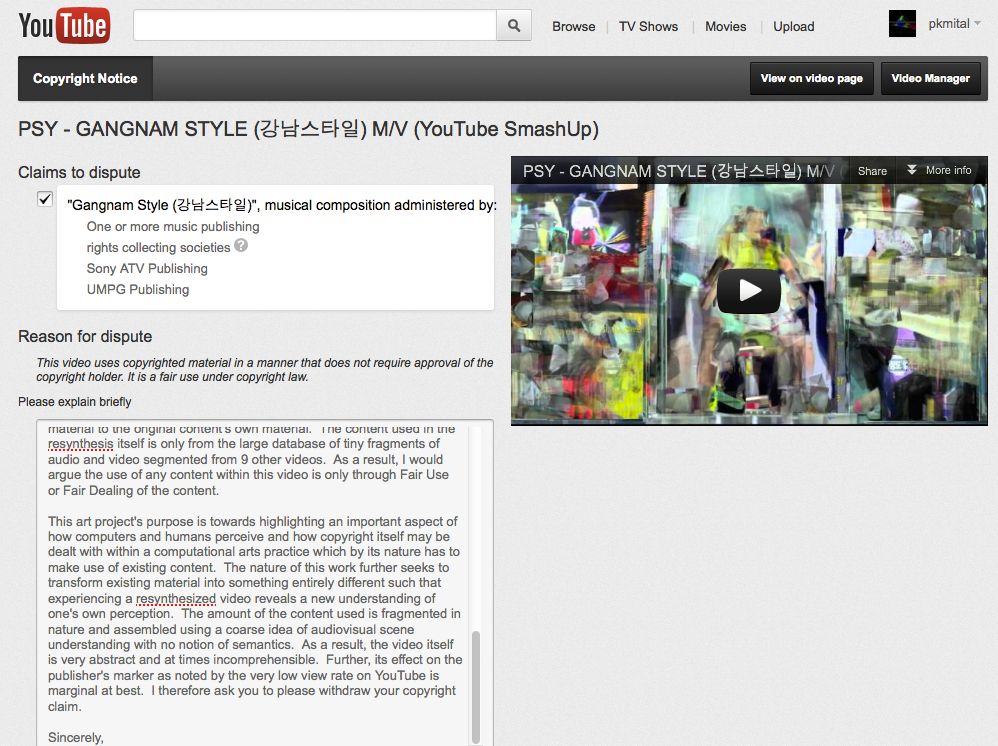


3 of the 4 have been dropped after I’ve filed disputes, though I’m still waiting to hear about the response to the above dispute. Read the dispute letter to Sony ATV and UPMG Publishers in full here.

The picture above shows a few stills from what my Smash Ups look like. The process described in greater detail on createdigitalmotion.com is part of my ongoing research into how existing content can be transformed into artistic styles reminiscent of analytic cubist, figurative, and futurist paintings. The process to create the videos … Continue reading...
Memory Mosaicing

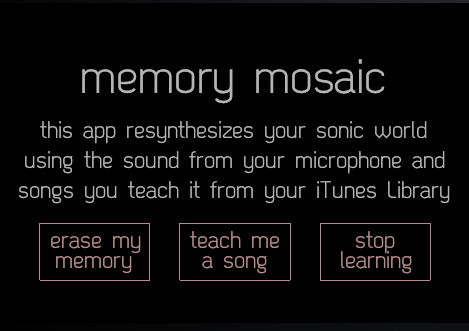
A product of my PhD research is now available on the iPhone App Store (for a small cost!): View in App Store.

This application is motivated by my interests in experiencing an Augmented Perception and of course very much inspired by some of the work here at Goldsmiths. The application of existing approaches in soundspotting/mosaicing to a real-time stream and situated in the real-world allows one to play with their own sonic memories, and certainly requires an open ear for new experiences. Succinctly, the app records segments of sounds in real-time using it’s own listening model, as you walk around in different environment (or sit at your desk). These segments are constantly built up the longer the app is left running to form a database (working memory model) for which to understand new sounds. Incoming sounds are then matched to this database and the closest matching sound is played instead. What you get is a polyphony of sound memories triggered by the incoming feed of audio, and an app which sounds more like your environment the longer it is left to run. A sort of gimmicky feature of this app is the ability to learn a song from your … Continue reading...


Copyright © 2010 Parag K Mital. All rights reserved. Made with Wordpress. RSS