Archived entries for appropriation

YouTube’s “Copyright School” Smash Up

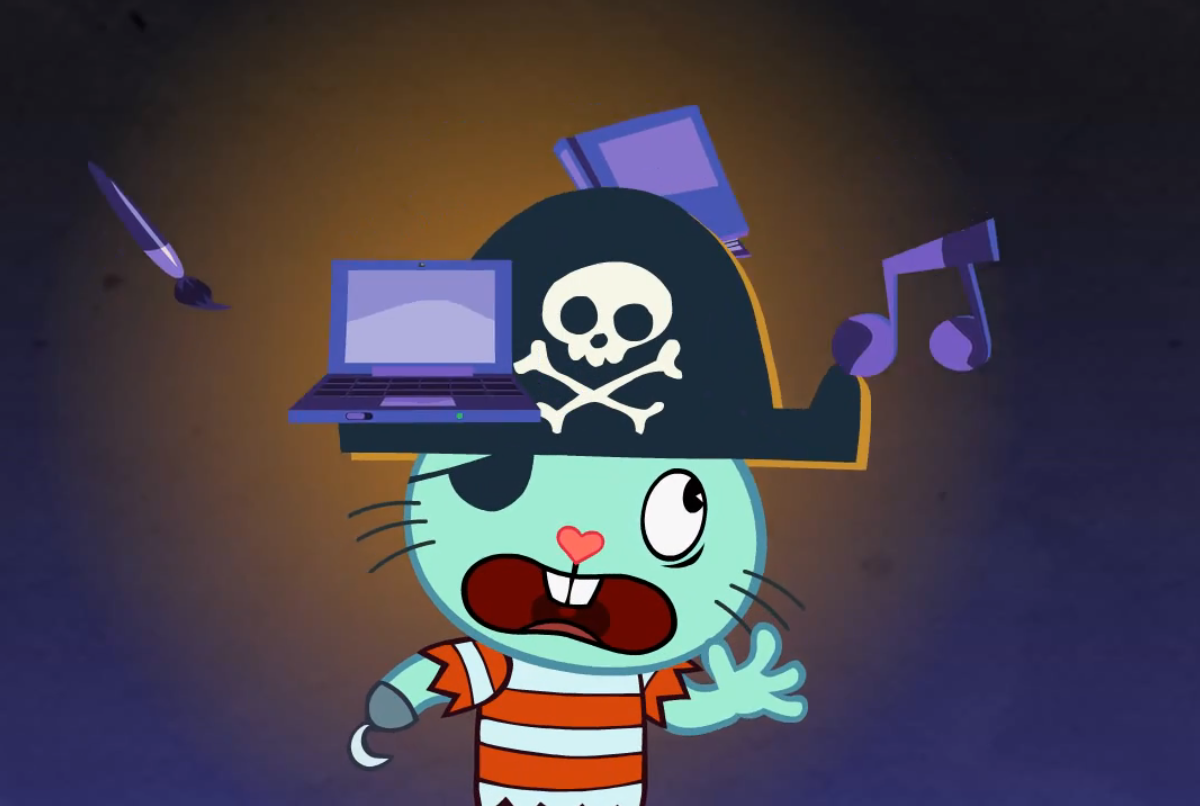
Ever wonder what happens when you’ve been accused of violating copyright multiple times on YouTube? First, you get a redirect to YouTube’s “Copyright School” whenever you visit YouTube, forcing you to watch a cartoon of Happy Tree Friends where the main character is dressed as an actual pirate:
Second, I’m guessing, your account will be banned. Third, you cry and wonder why you ever violated copyright in the first place.

In my case, I’ve disputed every one of the 4 copyright violation notices that I’ve received under grounds of Fair Use and Fair Dealing. Here’s what happens when you file a dispute using YouTube’s online form (click for high-res):

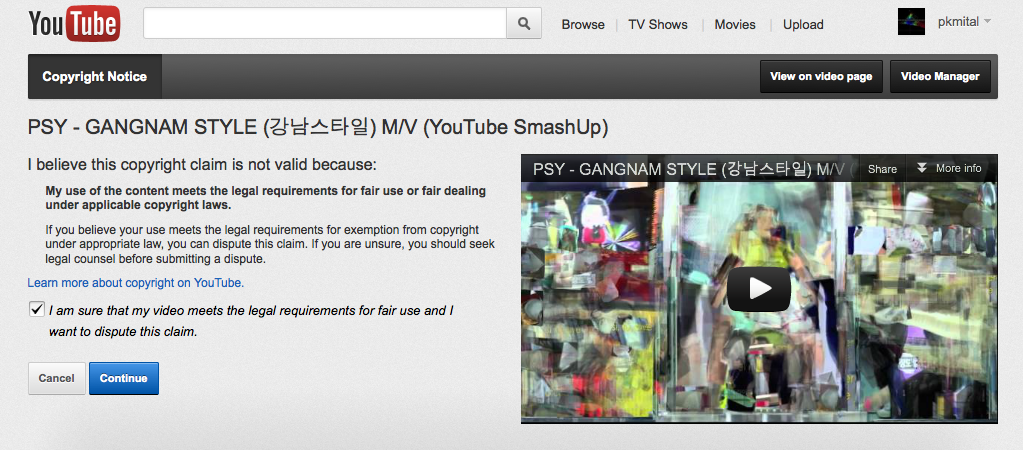

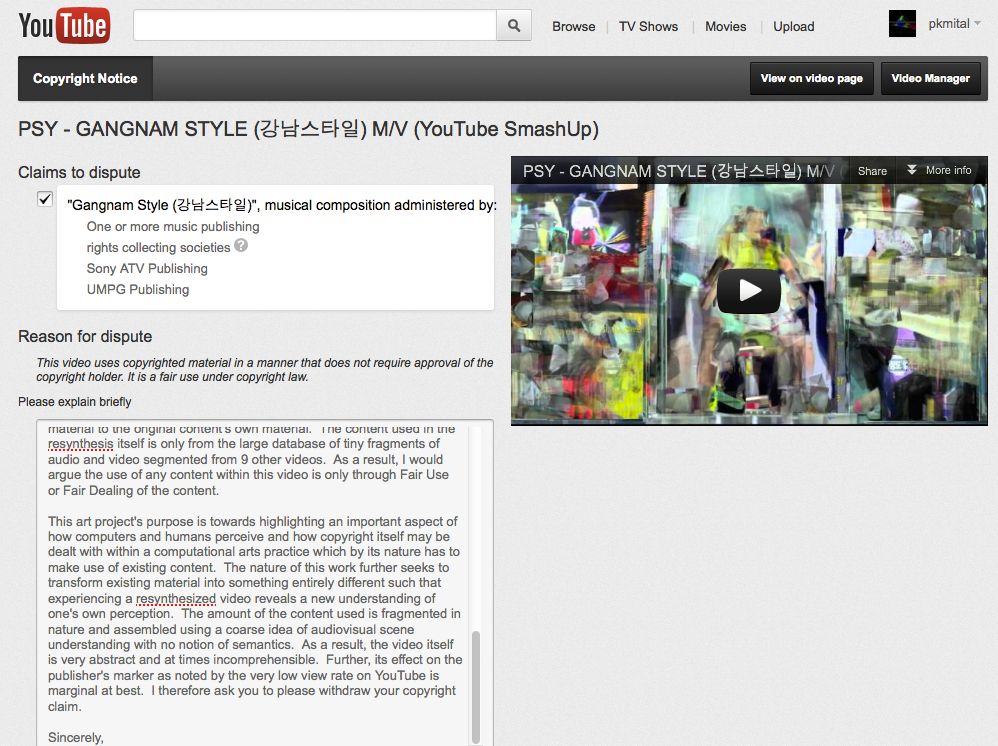


3 of the 4 have been dropped after I’ve filed disputes, though I’m still waiting to hear about the response to the above dispute. Read the dispute letter to Sony ATV and UPMG Publishers in full here.

The picture above shows a few stills from what my Smash Ups look like. The process described in greater detail on createdigitalmotion.com is part of my ongoing research into how existing content can be transformed into artistic styles reminiscent of analytic cubist, figurative, and futurist paintings. The process to create the videos … Continue reading...

Intention in Copyright

The following article is written for the LUCID Studio for Speculative Art based in India.

Introduction

My work in audiovisual resynthesis aims to create models of how humans represent and attend to audiovisual scenes. Using pattern recognition of both audio and visual material, these models use large corpora of learned audiovisual material which can be matched to ongoing streams of incoming audio or visual material. The way audio and visual material is stored and segmented within the model is based heavily on neurobiology and behavioral evidence (the details are saved for another post). I have called the underlying model Audiovisual Content-based Information Description/Distortion (or ACID for short).

As an example, a live stream of audio may be matched to a database of learned sounds from recordings of nature, creating a re-synthesis of the audio environment at present using only pre-recorded material from nature itself. These learned sounds may be fragments of a bird chirping, or the sound of footsteps. Incoming sounds of someone talking may then be synthesized using the closest sounding material to that person talking, perhaps a bird chirp or a footstep. Instead of a live stream, one can also re-synthesize a pre-recorded stream. Consider using a database … Continue reading...


Copyright © 2010 Parag K Mital. All rights reserved. Made with Wordpress. RSS